
What if therapy wasn’t something you had to survive, but something that helped you belong?
What if the plan started with who they are, not what they lack?
These aren’t slogans on a brochure. They’re questions we live by. They’re the questions that built K1ds Count Therapy- and they’re why we’re growing here in Carmel.
Too many families walk through our doors with a similar story:
They’ve been told, again and again, what their child can’t do.
What they’ll never do.
Where the deficits are.
Where the gaps are.
And you know what they rarely hear?
Where the spark is.
Where the strength is.
What happens when an entire team finally stops trying to fix, and starts helping that child be seen.
In Carmel, Indiana, we’re not opening a campus because data analytics and a map said it was a “great market.”
We’re here because this community deserves a therapy experience that’s different, not because it shouts louder about keywords or credentials, but because it serves louder with heart.
The Difference We Carry Into This Place
You could spend five minutes on Google and find a dozen therapy centers within driving distance.
And they’ll all promise the same thing: better outcomes, evidence-based programs, compassionate care.
But here’s what you can’t always see on a website:
How do they treat the child when the session is hard?
How do they treat the family when the insurance paperwork feels impossible?
How do they treat each other- SLPs, BCBAs, OTs, mental health therapists, PTs, when collaboration tests their egos?
At K1ds Count Therapy, we’re not pretending we’re the only ones who care. We’re saying we know that care alone isn’t enough.
Our mission secret is simple.
It’s called SERVE: Selflessness, Empathy, Resource, Value, Encouragement.
It’s not just our acronym. It’s our accountability.
Every child, every parent, every professional who walks through these doors should feel that difference immediately.
“It’s Not About Fixing Anyone. It’s About Finally Seeing Them.”
In the general world of pediatric therapy, there is a fondness for the word “goals.”
So many love to focus on and measure milestones.
There is a preoccupation with data sheets, targets, and progress charts.
But sometimes it is forgotten that behind the chart is a child who is so much more than a therapy plan.
The parents who come to K1ds Count Therapy carry this fear: Will this place see my child as a whole person? Or just a checklist?
We answer that every single day, by making sure our teams talk to each other, not just about each other.
By refusing to let an SLP’s plan contradict an OT’s.
By giving mental health a seat at the same table as behavior support.
By reminding ourselves that the real work is not just functional, it’s human.
A Place Where Neurodiverse Thought Isn’t an Afterthought

There’s a reason so many families whisper to us at a discovery visit, “We just want someone who gets it.”
So much of pediatric therapy has been built on the idea of compliance:
Sit still. Make eye contact. Be less “different.”
But Carmel doesn’t need another clinic teaching children how to mask. Carmel needs a space that teaches the world how to adapt.
When we opened this campus, we weren’t just opening therapy rooms and group rooms and sensory gyms.
We are opening minds.
We’re teaching families that stimming isn’t a problem, it’s self regulation.
We’re teaching schools that behavior is communication.
We’re teaching siblings that difference is not deficit, it’s a unique design.
And we’re teaching our clinicians, our BCBAs, our OTs, our SLPs, our mental health therapists, that the second we think we know everything is the second we stop being worth trusting.
“Therapy Shouldn’t Erase Difference. It Should Empower Identity.”
Our Carmel families will find a team that doesn’t see autism, ADHD, or sensory processing differences as obstacles to fix, but as truths to understand.
We’re not romanticizing struggles. We’re just refusing to punish it.
That’s why our therapists are trained, not just to “deliver services,” but to deliver dignity.
That’s why we put collaboration first, even when it’s inconvenient.
That’s why our walls aren’t filled with marketing posters about “ourselves”; they’re filled with kids’ artwork, because their voices are what matter here.
“What If Therapy Wasn’t Something You Had to Survive, But Something That Helped You Belong?”
Because every parent in Carmel, Westfield, & Fishers who has spent nights searching for answers on Google wants the same thing:
To belong to a place that gets it.
To belong to a team that says, “We’ll walk this with you.”
To belong to a vision that says, “Your child’s worth was never in question.”
Our SERVICES: What We Actually Do
If you strip away the buzzwords, here’s what happens inside our walls:
Today’s Modern Applied Behavior Analysis (ABA) – rooted in respect, not rigidity. We use evidence-based behavioral discovery strategies to build life-changing skills, but we do it through compassion, not compliance for compliance’s sake. Every behavior plan is a living conversation between the therapist, the family, and the child. If it’s not working for the child, we change it.
Speech and Language Therapy (SLP) – because words matter. For a non-speaking child, finding a way to express “I want” or “I need” can unlock an entire new world. Some learn verbal speech, some use AAC. We don’t force “typical”, we build functional.
Occupational Therapy (OT) – the art of the daily living moment. Sensory integration, fine motor skills, and executive functioning. The things other people take for granted, brushing teeth, sitting at circle time, cutting with scissors, our OTs break these skills down to build kids up.
Physical Therapy (PT) – for the kids whose bodies work just a bit differently. Our PTs help strengthen muscles, build endurance, and boost confidence. It’s not about running the fastest, it’s about giving kids the strength to show up in their own lives.
Mental Health Therapy – this is one of the things that makes K1ds Count Therapy stand out. We don’t treat mental health like an add-on. We weave it into the plan from day one. Because trauma, anxiety, and self-esteem don’t wait until you’re “older.” Our families deserve a safe place to unpack those pieces too.
A Day Inside Our Walls
Walk through our Carmel campus or any of our four campuses on any given Tuesday morning, and here’s what you might see:
A three-year-old using a speech-generating device to tell her RBT she wants goldfish crackers. That same child, later, sitting with an OT to figure out why the crunchy texture helps her stay regulated.
A teenager working with a BCBA to generalize social skills he’s learned, but with a mental health therapist looping in to help him navigate the anxiety that flares when he tries those new skills with peers.
A preschooler in a sensory gym, swinging back and forth, giggling with a therapist. What looks like play is actually finely tuned vestibular input, part of an OT plan that makes it easier for that child to sit calmly in circle time later.
A mom, sitting in our family resource room, reading a binder our staff put together just for her, reminders about Medicaid renewal, local parent groups, trusted providers for specialized equipment. Not because it’s our “job description.” Because it’s our promise.
Collaboration That Doesn’t Just Sound Good- It Works
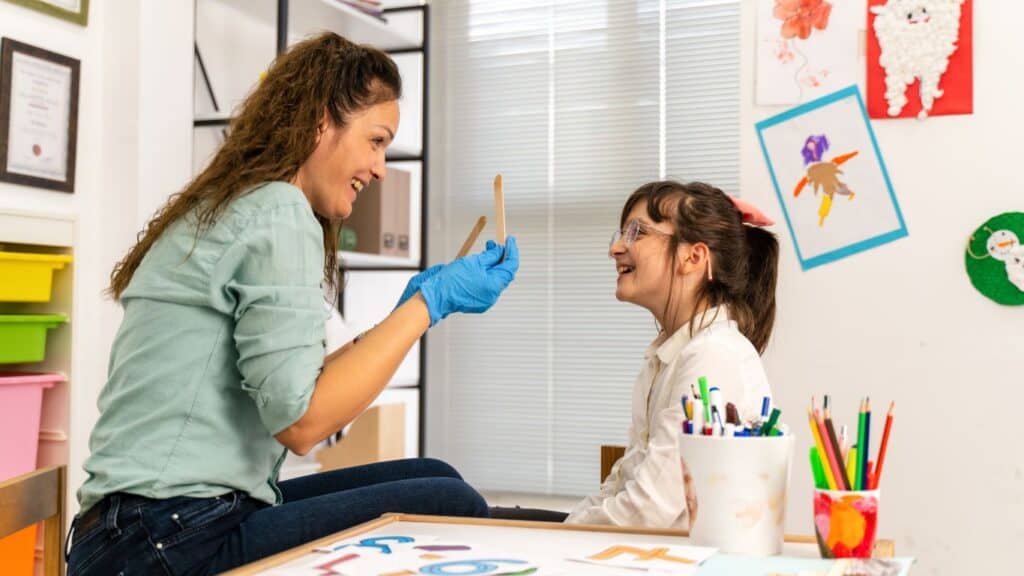
In the world of pediatric therapy, every discipline says they collaborate.
But ask parents how often that happens, and you’ll get the real truth.
When we opened our first center in 2015, we learned fast: real collaboration doesn’t happen by accident.
It happens when you’re willing to do the hard things:
To check your ego at the door.
To share the “why” behind your plan.
To admit when another perspective might help your approach.
A BCBA and a mental health therapist might not see behavior the same way, but when they share a child’s story, the plan that comes from that synergy is always better.
An SLP might hold the keys to communication, but an OT might hold the keys to regulation, so the words can come out at all.
A PT might build strength and endurance, but the mental health therapist keeps the spirit strong enough to try again when it gets hard.
This is what Carmel will feel:
One team. One child. One story. Told together.
This Isn’t Just About Therapy Rooms. It’s About a Community.
If you ask the families who trust us what makes K1ds Count Therapy different, they won’t say “better billing systems” or “fancier swing sets.”
They’ll say, “They saw us. They walked with us. They made us feel like we could breathe again.”
Carmel deserves that. Central Indiana deserves that.
And that’s what this new campus will be, a place where the next chapter is written with hope, not fear.
What Parents Deserve to Know
This isn’t just therapy for the kids. It’s support for the whole family.
Our Family Support Coordinators guide you through insurance. They don’t treat you like you should have a medical degree to get a claim approved.
Our Clinical Directors make sure you don’t have to juggle contradictory recommendations, you get one clear path that makes sense for your child.
Our therapists pick up the phone when you call. And they listen, really listen, when you say, “This isn’t working for us.”
We want you to know: you belong here. You don’t have to be an expert on day one. We’ll walk this with you.
To the Community: Let’s Build This Together
To Carmel – this is your building as much as ours.
We want to be the place that schools can call when they need help understanding sensory needs.
We want to be the place that pediatricians trust when they see a child struggling and know they need a team that won’t just push a cookie-cutter plan that hits 40 hours per week.
We want to be the place that neighbors talk about when they see a child, once hidden in their struggles, now showing up with confidence at the park.
Final Word: The Loudest Voice Is Still the Child’s
Therapy is not about us. It’s not about the degrees on the wall or the fancy acronyms or the hours of CEUs.
It’s about the child who walks in each day, eyes wide, wondering: Will you see me today? Or will you try to fix me?
We choose to see them. Every single time.